Showing posts with label users. Show all posts

Saturday, June 15, 2013

And the study says: Windows 8 users rarely touch Metro apps

AppId is over the quota
Windows 8 Professional $200.00 Windows 8 isn't for everyone. If you're mostly a desktop PC user comfortable with Windows 7, upgrading to Windows 8 is probably not worthwhile. If you're a mobile user who needs easy access to the...

If you were going to sum up Windows 8 in a single sentence, “It’s all about the apps” would do the trick. And that’s why a new study from Soluto, a company that offers a remote troubleshooting tool for Windows PCs, suggests a somewhat stark reality for Microsoft's new-look operating system.

Windows 8 was rebuilt from the ground up to revolve around finger-friendly Windows apps. The modern UI Start screen is chock-full of Live Tiles generated from those apps, virtually all of Microsoft’s default programs sport that oh-so-modern (a.k.a. the interface formerly known as Metro) luster, and users don’t even get the option of booting straight to the desktop. You have to stare the Start screen’s shiny, shifty app collection in the face every time you boot up your PC.

With that heavy a focus, Windows 8’s very future hinges on the success of its apps. Soluto’s report digs into how often people really use those apps on a daily basis.

The news isn’t wonderful. Of the 10,848 Windows 8 devices studied by Soluto, the majority of traditional desktop and laptop users—even ones using a device with a touchscreen—fail to open a modern-style app daily. (Note that this study refers only to modern apps, not to traditional desktop programs.) Even on tablets, the devices best suited for Windows 8’s modern UI, just 56 percent of all users launch a Windows 8 app day in and day out.
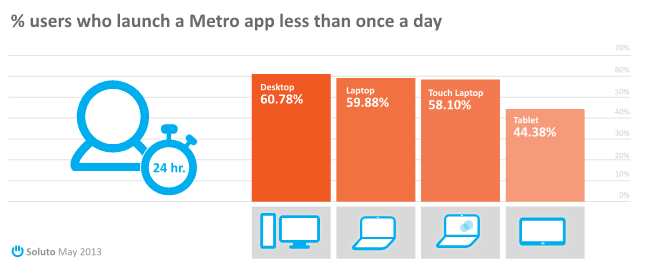
Soluto(Click to enlarge.)

Soluto’s data backs up what we’ve all been saying all along: Modern UI apps flat out work better on a touchscreen. Tablet users open modern apps nearly twice as frequently as desktop users, and people who rock touchscreen laptops launch modern apps 47 percent more often than their non-touch brethren.

Soluto(Click to enlarge.)

There’s a big caveat here: A Soluto representative told me that all of the data used in its study was culled from Windows 8 proper, as the company’s software does not yet support Windows RT. Since Windows RT tablets—like Microsoft’s own Surface RT—are limited to using only modern UI apps, their app usage rates would no doubt be much higher.

Don’t sweat the omission too much, though. Recent reports suggest Windows RT is languishing on the vine, with the IDC research group estimating that just 200,000 Windows RT units sold in the first quarter of the year.

Soluto also tracked which apps are being used the most. Unsurprisingly, all but one of the top ten entries are preinstalled Microsoft apps. (Netflix cracked the list at number eight.) What's a bit surprising, however, is how rarely most apps—especially non-Microsoft apps—are being used.

Soluto

Only Windows Reader, Windows Photos, Windows Camera, and the core communication apps—like Mail and Calendar—are being used by more than 10 percent of users. That quartet consists of defaults tied to basic functions of the OS. (Soluto representatives told me the modern version of Internet Explorer 10 was not included in this study.)

The Soluto report has a full breakdown of the top 20 most-used modern UI apps, along with other interesting data points, if you’re curious.

When contacted, a Microsoft spokesperson supplied the following statement:

Consumers are excited about the apps in the Windows Store and are using their favorite apps across their Windows 8 PCs and tablets. We’ve already passed the 250 million app download mark just six months after general availability, and almost 90% of our app catalog has been downloaded every month. We have more than 70,000 apps in the Windows Store, including favorites like Twitter, Netflix, Angry Birds, Evernote, eBay and Amazon, and more apps are added every day.

While you could try to put a positive spin on Soluto’s report—almost 40 percent of desktop users open a modern app every day!—the truth behind the numbers is a bit drearier than Microsoft’s rosy picture might lead you to believe.

Windows 8 doesn’t include traditional desktop programs for email, basic document or photo opening, calendar functionality, contact management, or SkyDrive access. Windows Media Player comes preinstalled, but the system defaults are the Music and Video apps.

In other words, if you want to use Windows 8 out of the box, you have to use finger-friendly apps. Even so, Soluto’s numbers suggest that such use simply isn’t happening as often as Microsoft no doubt wants it to be.

windows 8

Most Windows 8 users aren’t using a modern app daily. The vast majority of the most-used apps get used less than once per week, core communication apps aside. Most of the apps that are being used are critical apps baked into the operating system by Microsoft, not shining stars from third-party publishers.

Read between the lines, and you can see that users are still turning to the desktop for their everyday computing needs, despite the desktop’s “Just another app” status in Windows 8.

And who can blame them? The Windows Store still lags behind competitors in overall quantity and quality, and it’s plagued by several prominent no-shows months after launch. Microsoft’s own numbers show an average of just 2.5 modern UI apps are downloaded for each Windows 8 license.

The problems go deeper than that, however. The default apps included with the OS, while beautiful, lack some of the basic functionality found in desktop alternatives. And while it’s certainly possible to use modern apps with a keyboard and mouse, doing so isn’t exactly pleasurable when compared to the mouse-optimized interfaces of classic software.

Hints of a possible desktop resurgence in Windows Blue should come as no surprise. But all that said, Microsoft is nevertheless on the right track, and it always plays the long game.

Big-name additions like Twitter, MLB.tv, and a free Adobe Photoshop Express app are starting to sneak into the Windows Stare regularly, and Microsoft’s shift to incremental, rapid-fire improvements is already starting to pay (similarly incremental) dividends for Windows 8’s core apps.

Microsoft is also prepping Windows Blue, a free update to the core Windows 8 experience. Early leaks suggest shoring up some of the most glaring flaws with the modern UI is a priority. If you make the modern UI more palatable, you make modern UI apps more palatable.

Microsoft

Perhaps most important, touchscreen laptops are finally starting to pick up steam, nabbing 10 percent of the overall notebook market in the first quarter. For modern apps to shine, touchscreens must be ubiquitous.

No, Microsoft’s modern-style vision for the future isn’t quite here yet—assuming that Soluto’s numbers scale true (and there’s no reason to suppose that they don’t). The world, it seems, isn’t quite ready to ditch the desktop completely. But the groundwork has been done.

Revolutionizing Windows as we know it is a long journey, not a quick sprint, and one taken baby step by baby step—even after the heavy-handed introduction of the modern UI.


View the original article here

Monday, April 8, 2013

Review: Magix Page & Layout Designer includes advanced tools for beginner users

AppId is over the quota

Printed media may seem to be heading the way of the dinosaur, but until the proverbial meteor hits a stack of business cards, box of letterhead, or freshly-printed brochures on their way to a conference, we'll continue adding paper and ink (and the odd PDF) to our marketing cache.

MAGIX Page & Layout Designer ($150)  anticipates the needs of a growing business by providing a single source for designing anything from a single logo to business cards to a multi-page brochure. However, if you are a Xara Photo & Graphic Designer ($89) fan, you will recognize the UI instantly, and may be left feeling ripped off. It's so hard to find a difference between the two apps, it seems that MAGIX has repackaged Xara with added templates and an inflated pricetag (although Page & Layout Designer is currently on sale for $90).

About a dozen template themes are included in the MAGIX Page & Layout Designer download (you can't access or view them all in the trial). Choose a theme that suits your business, then open business card, brochure, and letterhead templates that all match the theme and are fully customizable with your own logo, text, images, etc. There are about 100 templates in total. All are royalty-free, and many verge on stylish, but organization isn't great. It can be hard to find the matching brochure to your business card design.

MAGIX Page & Layout Designer's slide-out bitmap gallery could mean you never need to hunt and gather on the server for your company's logo again.

Customizing the templates is pretty easy with MAGIX Page & Layout Designer, even if you don't have any design training or experience. For example, a snap function helps you align objects, text is set to automatically flow around your images, and you can chose to work without or without layers.

If you do have prior experience, setting up a page from scratch also is simple and intuitive. Plus, you can easily use MAGIX Page & Layout Designer to create logos and other vector drawings without too much difficulty; and use the photo tools to adjust and manipulate your images. Refer to the Xara Photo & Graphic Designer 2013 review for more detail on how drawing and image editing tools work, since these are identical.

Currently, Magix Photo Manager MX Deluxe ($59) is included in the Page & Layout Designer download for free, and also includes some additional basic photo manipulation tools as well as the ability to organize your images. On the surface, this looks like a great deal. However, you may not need Photo Manager at all, as MAGIX Page & Layout Designer includes a slide-out bitmap gallery. With it, you can save and access all of your logos, logotypes, images etc. for any of your projects. However, I wish it were easier to organize things, and would love to be able to add text boxes (so you never again have to cut and paste your mission statement and other often-used blocks of text).

It seems like MAGIX is trying to reach a new audience with Page & Layout Designer, with no mention of its powerful vector drawing tools and super-easy photo editing in their marketing of the product. But the non-sale pricetag is steep unless you were actually considering also purchasing the bundled Photo Manager MX Deluxe. If you already own Xara Photo & Graphic Designer (or Xara Designer Pro, the $299 heavy-lifter in the family) you are going to be an unhappy T-Rex who'll want to eat MAGIX for lunch.

Note: The Download button on the Product Information page will download the software to your system.


View the original article here

Monday, February 18, 2013

Support for international users and multiple languages in the new Office

AppId is over the quota

Julian Parish is the Senior Product Planner in Office International, responsible for coordinating language and market strategy across Office products and services.  He is based at Microsoft's EMEA head office in Paris, France. 

We have made major new investments in the new Office to support international users who work in languages other than English.  Three new languages have been fully localized for the first time and Language Interface Packs added in 13 more.  The range of languages supported in Office 365 and in Office Mobile has also been greatly extended. For the many international users who need to consume or create content in more than one language we are introducing new ways to access Office proofing tools in additional languages.  

We know how important it is for you to feel comfortable using our applications and to be as productive as possible. A key part of that is to use Office in a language you know well or use regularly in your work. We are continuously reviewing the languages we support. As the economies in emerging markets grow further and more people come online around the world, we need to take Office into new languages. In fact, in the past ten years we have increased the number of localized Office languages by over 50%. In the new Office we are therefore investing in two major ways.

 German language Word

Word 2013 templates in German

First, we are adding new fully localized versions of Office in three Asian languages: Indonesian, Malay and Vietnamese.  This means that the User Interface (UI) and User Assistance (UA) content will be available in these languages across Office--including Lync--and as a Language Pack for SharePoint Server 2013.   These new language versions will be available to consumers to buy in 2013 and to enterprise customers as part of our Multilingual User Interface or MUI packs.  Alongside the Office Client a dedicated Office.com site in the local language will provide more help and tools for making the most of the new Office.

PowerPoint 2013 in Malay

PowerPoint 2013 in Malay

Secondly, and working closely with our partners in Windows, we are adding thirteen completely new languages as Language Interface Packs to the new Office.  These packs--or LIPs for short--provide a localized User Interface (UI) for the most frequently used Office Client applications: Excel, OneNote, Outlook, PowerPoint and Word.  They run on Windows 7 and Windows 8 and will be available in 2013 as free downloads; they can be quickly installed on top of Office 2013 in a base language such as English.  The same languages can also be used as Office Web Applications in conjunction with Microsoft SkyDrive.  Together, these solutions will make the new Office available to speakers of national languages in markets which are experiencing rapid PC growth (in Africa and Asia, for example) and of additional languages that are preferred by groups of customers in developed markets.  

These are the LIP languages we are adding in the new Office:

table of Language Interface Packs 

With these additional investments, the new Office will be available in 106 languages as either a fully localized language or Language Interface Pack.  Taken together, these languages are spoken as the first language of more than 4.5 billion people across the globe.  They cover at least one official language in nearly every country in the world.

PowerPoint in Japanese

PowerPoint 2013 in Japanese

Changes to the international support in the new Office are not limited to these extra languages.   As more and more of our customers move to our new cloud-based service offerings, we have massively increased the range of languages and markets available in Office 365.  Already, Office 365 is available in 88 markets and 32 different languages, with more planned to come online in the next year.   

The perfect partner to Office in the cloud or on your desktop, Office Mobile will be available in many more languages to accompany the release of Windows Phone 8.  Altogether, we will support 51 different languages.

With each new release, we look at the languages we localize each of the Office applications into.  In Project and Visio, for example, we are adding support for Romanian on top of the 27 languages already localized in Office 2010. 

We have also made significant changes to the Extent of Localization for the Lync family of products.  For the Lync Client, Lync Web App and Lync Admin Center 2013 we will provide a consistent end-to-end user experience in 44 languages.  Language switching for the Lync Client will now be possible as part of the central Office language settings.  For Lync Server we are adding a new localized version in Russian.  Finally, we are stepping up our language coverage for the Lync Desktop Phone Edition software, with ten new languages added (Arabic, Czech, Croatian, Hebrew, Hungarian, Polish, Romanian, Slovak, Turkish and Ukrainian), bringing the total to 26.

During the development of the new Office we have worked  with our worldwide partners and MVPs to improve not just the range of languages we support, but also the quality of the experience in the local language.  For this release more than 8,000 localized terms have been changed and a new, modern voice adopted.  This is clearer, less formal and more up to date, whether providing help on a new feature or in error messages. 

Being able to navigate confidently in the new Office, using the UI language you want, is only half the story.  Just as important for many of our customers is to be sure of using the right spelling, finding a synonym or checking a point of grammar, whether it's for a proposal in Word or a presentation in PowerPoint.  In the new Office we have made significant investments in our proofing tools:

A feature much requested by our customers has been to add spell-checking in the subject line of Outlook messages

 Outlook spellcheck

There are new thesauri (or dictionaries of synonyms) in Bulgarian, Latvian, Lithuanian and Serbian. The thesaurus feature--in all available languages--can now be accessed in PowerPoint for the first time

 dictionaries of synonyms

The grammar-checking functionality is now available in OneNote

A new definitions feature--available in 22 languages--lets you check the meaning of a word as part of the Proofing Pane. Dictionaries for this feature can be quickly and easily installed--free of charge[1]--from the Office Store

Research carried out by our planning teams has shown that up to 45% of Office users regularly read or create content in a second or further language, often English for people who do not speak English as their first language.  For these users we need to make it as easy as possible to find and use the proofing tools in each language they speak and not just their first language. 

In Office 2010 we already include the proofing tools for two or more "companion" languages with each language version.  The English version of Office, for instance, includes all the proofing tools for French and Spanish.  This feature will continue in the new Office, but we are going beyond it to introduce a completely new approach to proofing in multiple languages.  The range of language combinations users may need is almost limitless: a company in Germany may need Greek to do business with customers or partners, a family in the US with relatives originally from Italy may want to send mail in Italian as well as English.  To help all these users, we are introducing enhanced functionality to our existing Language Auto-Detect feature.

Imagine that you have an English version of the new Office installed on your PC, but want to write a document in Portuguese.  As you start typing your content in Portuguese, Language Auto-Detect will now recognize that you are writing in Portuguese and that you don't currently have the Portuguese proofing tools installed.  A pop-up message appears inviting you to download complimentary proofing tools for that language.  Minutes later, you can continue writing with full support to check your spelling and enrich all your Portuguese documents.

proofing tools popup

This new approach to proofing was introduced for the Consumer Preview of the new Office in summer 2012 and is available now in 50 languages.  Already, more than 700,000 users have downloaded proofing tools for additional languages; if you are using the Consumer Preview, why not visit the Office Language Options page and try them yourself?

We hope you like the changes we have made in our support for international users and multiple languages in the new Office.  If you have suggestions for further improvements or would like to hear more about language-related topics, please let us know in the comments below!

--Julian Parish

[1] Internet access required, fees may apply.


View the original article here

Sunday, December 30, 2012

Over 25 million active Outlook.com users, and today we’re making it even easier for Gmail users to switch

AppId is over the quota

"The best reason yet to ditch Gmail" - Farhad Manjoo, Slate.com

Since the new Outlook.com launched in July, the positive feedback has been overwhelming.  Outlook.com was recently named one of Time Magazine's "50 Best Websites of 2012", won PC Magazine's Best Software and Internet Web App awards and has received a number of other accolades around the world.  To date, over 25 million of you are already actively using the new Outlook.com:

Outlook.com graph

We found that about a third of Outlook.com users are active Gmail users trying Outlook.com for the first time.  We wanted to learn more, so we hired a research firm to recruit hundreds of Gmail users - people that use Gmail as their primary email service - and asked them to try Outlook.com.  We asked the Gmail users to sign-up for Outlook.com addresses, forward email from Gmail to Outlook.com, and try Outlook.com's best features.  The Gmail users loved it.  Specifically, they shared the following opinions with us:

They prefer Outlook.com's clean user designOutlook.com does a better job of blocking spam and it outperforms Gmail when it comes to helping manage unwanted messages like newsletters and daily dealsOutlook.com makes it easier to share photos and Office documents

The best part was, after spending just five days with it, 4 out of 5 of these Gmail users said they would switch to Outlook.com.

As millions of people have made the switch to Outlook.com, they've told us about the features that made the transition easier:

Keyboard Shortcuts: customers can choose to set up keyboard shortcuts in Outlook.com to mirror the shortcuts in the Outlook desktop app, Gmail and others.Quick access to search operators: quickly find mail by clicking "/" and then using "To:", "Subj:", etc. Tab/Send: rapidly send messages by clicking the "tab" key from the compose window to automatically shifts focus to the "Send" button Conversation threading: you can also optionally turn on conversation threading (i.e. the ability to see all responses in a conversation via just one view).

But it's still early days.  We continue to listen to feedback on what enthusiasts want next - including making the switch from Gmail even easier - and build those features.  So over the next few weeks, Outlook.com users will start to see these new features in their inboxes:

One-click Archive: from the inbox, select messages and click the Archive button to move the selected messages to the Archive folder (or any other folder of your choice). It's a fast and simple way to move messages out of your inbox to find later.

Outlook.com one-click archive

More and more keyboard shortcuts: Outlook.com has dozens of keyboard shortcuts and we're adding even more. And better yet, we don't need to list them all in this post because you can now find all available keyboard shortcuts by simply typing a question mark when you're in your inbox.

Outlook.com keyboard shortcuts

More customization of your inbox: we added several new ways to make your inbox look and work the way you want.

   We added more color themes:

 Outlook.com customization

We added the ability to toggle between "Reply" and "Reply All" as the default option.  We also heard that, after deleting a message, some people want to return to their inbox and others want to see the next     message. Now you can set that default option, too.  Both options are available via the Options page. 

Outlook app for Android: Many of us use Outlook.com as much on our phones as we do on a PC. For devices like Windows Phone and iPhone that support Exchange ActiveSync, you have built-in support for Outlook.com - no download necessary. Android devices aren't consistent in their native support for Exchange ActiveSync, so starting today you can install an Outlook.com for Android on your mobile phone. The new app is free and works on all Android 2.x devices and higher.

Outlook.com Android display

If you're one of the tens of millions of people that have made the switch to Outlook.com, we thank you.  We're committed to making Outlook.com the best email service and we appreciate the feedback you continue to provide. 

If you are a Gmail user and are still on the fence, take a look at our new features and give Outlook.com a try with just a few simple steps. 

Thanks again for using Outlook and, as always, keep the feedback coming.

David Law--Director, Product Management, Outlook.com


View the original article here

Monday, June 11, 2012

Training: Adobe Photoshop basics for Adobe Captivate 5.5 users – Part 1

February 29, 2012

Date and time: Thursday, March 8, 2012 8:00 AM – 9:00 AM US/Pacific

Description: Join Vish and Dr. Pooja Jaisingh to learn the basics of Adobe Photoshop for creating and editing images/assets for Adobe Captivate 5.5. This is the first part of 2 part series wherein we will discuss different techniques used in creating and managing the image assets.

What’s in it for you?

After attending the session, you will be able to:

Export the Captured images from Adobe Captivate for editing, edit it in Adobe Photoshop, and import it back into Adobe CaptivateUnderstand the image and canvas dimensionsCreate backgrounds using different tools available in Adobe PhotoshopCreate image masks to edit the imagesCreate Transparent PNGs to be used inside Adobe Photoshop

To Register: http://adobe.ly/z3GWyK


View the original article here

Sunday, June 10, 2012

Training: Adobe Photoshop basics for Adobe Captivate 5.5 users – Part 2

February 29, 2012

Date and time: Thursday, March 22, 2012 8:00 AM – 9:00 AM US/Pacific

Description: Join Vish and Dr. Pooja Jaising to learn the basics of Adobe Photoshop for creating and editing images/assets for Adobe Captivate 5.5. This is the second part of 2 part series wherein we will discuss different techniques used in creating and managing the image assets.What’s in it for you?

After attending the session, you will be able to:

Create graphics to be used as buttons in Adobe CaptivateCreate graphics to be used as Text Caption BackgroundsUnderstand and create layer compsUse the layer comps in Adobe Captivate for various layouts

To Register: http://adobe.ly/zjHYlu


View the original article here